Introduction
With increasing internet restrictions and privacy concerns, many users turn to proxy servers to access blocked websites and browse anonymously. Proxies are widely used because they are easy to access and often free. However, an important question arises: is a proxy actually safe?
The answer is not straightforward. While proxies can hide your IP address and help bypass restrictions, they do not always provide strong security. In some cases, using a proxy can even expose your data instead of protecting it.
This article explains how proxies work, their safety level, potential risks, and when you should use safer alternatives.
What is a Proxy?
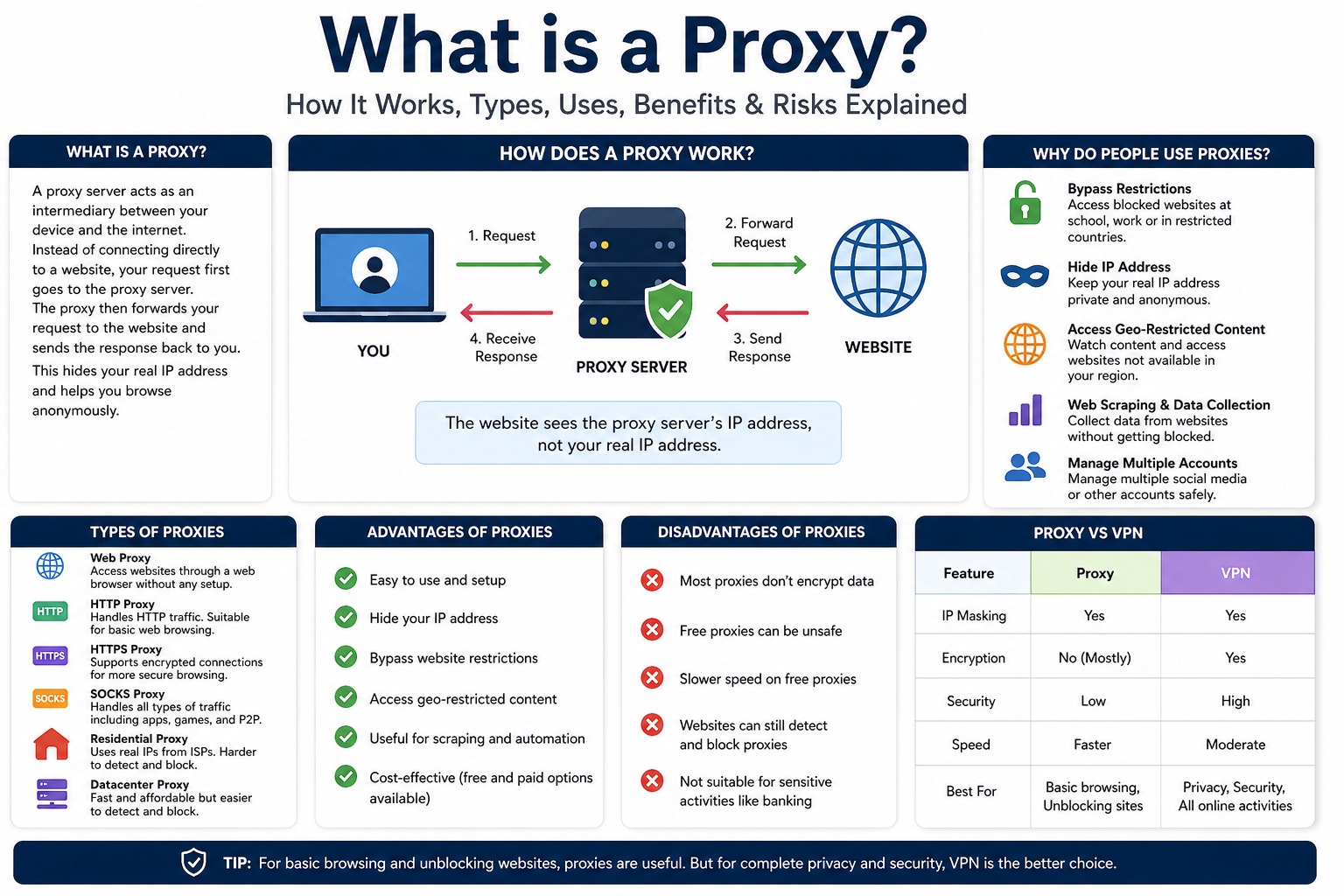
A proxy server acts as an intermediary between your device and the internet. Instead of connecting directly to a website, your request is first sent to the proxy server. The proxy then forwards the request to the target website and returns the response to you.
This process hides your real IP address and replaces it with the proxy server’s IP. As a result, the website cannot directly identify your location or device.
Are Proxies Safe?
Proxies provide basic anonymity, but they are not fully secure. They can hide your IP address, but most do not encrypt your internet traffic. This means your data can still be visible to third parties such as hackers, network administrators, or even the proxy provider itself.
In simple terms, proxies are safe for basic tasks but not for sensitive activities.
When is a Proxy Safe to Use?
Proxies can be considered relatively safe in the following situations:
Basic Browsing
Using a proxy to read articles or access general content is usually safe because no sensitive data is involved.
Accessing Blocked Websites
Proxies are commonly used to bypass restrictions at school or workplaces.
Non-Personal Usage
If you are not entering passwords, banking details, or personal information, the risks are lower.
When is a Proxy Not Safe?
There are several situations where using a proxy is not recommended:
Logging Into Accounts
Entering usernames and passwords on a proxy can expose your credentials.
Online Banking or Payments
Financial activities require strong encryption, which most proxies do not provide.
Using Unknown Free Proxies
Free proxies often lack security and may track or misuse your data.
Major Risks of Using Proxies
Lack of Encryption
Most proxies do not encrypt your data. This means your internet activity can be intercepted, especially on public networks.
Data Logging
Some proxy providers keep logs of your browsing activity and may sell this information to third parties.
Malware and Ads
Untrusted proxies can inject malicious scripts, advertisements, or trackers into websites.
Identity Exposure
Although proxies hide your IP, advanced tracking methods can still identify users.
Unstable Performance
Free proxies are often slow, unreliable, and may disconnect frequently.
Types of Proxies and Their Safety
Web Proxies
These are browser-based proxies. They are easy to use but offer the lowest level of security.
HTTP Proxies
Used for basic web browsing. They do not encrypt data.
HTTPS Proxies
More secure than HTTP proxies as they support encrypted connections, but still not fully secure.
SOCKS Proxies
More flexible and capable of handling different types of traffic, but security depends on configuration.
Residential Proxies
Use real IP addresses and are harder to detect, but safety depends on the provider.
Proxy vs VPN: Which is Safer?
Proxies and VPNs are often compared, but they serve different purposes.
A proxy only hides your IP address, while a VPN encrypts your entire internet connection. This encryption ensures that your data remains secure even on public networks.
Proxies are suitable for quick access to blocked websites, but VPNs are better for privacy, security, and long-term use.
How to Use Proxies Safely
If you choose to use a proxy, follow these safety practices:
Use trusted and reputable proxy services
Avoid entering personal or financial information
Prefer HTTPS websites
Do not rely on free unknown proxies
Use additional security tools when necessary
When Should You Use a VPN Instead?
A VPN is a better choice in the following situations:
When using public WiFi networks
When accessing sensitive accounts
When streaming or downloading content
When privacy and security are important
A VPN encrypts your data, hides your IP address, and provides a secure browsing environment.
Common Misconceptions About Proxies
Many users believe that proxies provide complete anonymity. This is not true. Proxies only offer basic privacy and do not protect against advanced tracking or data interception.
Another misconception is that all proxies are safe. In reality, many free proxies are risky and should be avoided.
Conclusion
Proxies are useful tools for accessing blocked websites and hiding your IP address. However, they are not designed to provide full security or privacy. While they may be safe for basic browsing, they are not suitable for sensitive activities such as logging into accounts or making financial transactions.
If your goal is convenience and quick access, a proxy can be useful. But if you want true privacy and protection, a VPN is the better and safer option.
FAQs
Is a proxy safe for daily use?
It is safe for basic browsing but not recommended for sensitive activities.
Can a proxy protect my data?
No, most proxies do not encrypt your data.
Are free proxies safe?
Free proxies can be risky as they may track or misuse your data.
What is safer, proxy or VPN?
A VPN is safer because it encrypts your internet connection.
Can a proxy hide my identity completely?
No, proxies provide limited anonymity and cannot guarantee full privacy.